Important Things to Consider:
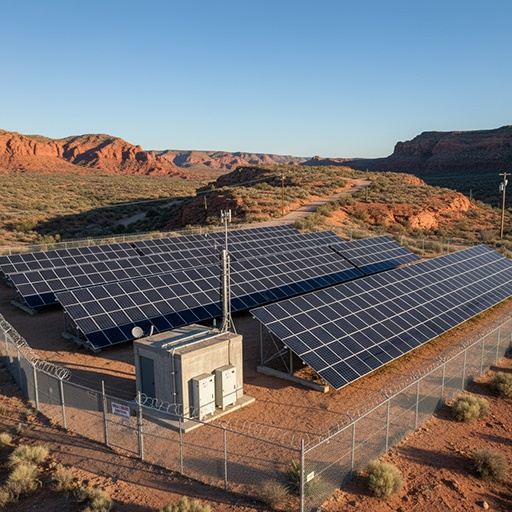
Designing an off-grid system starts with identifying the daily load requirement, typically in watt-hours. For a small home or shop with basic lighting and fan usage, a 500W to 3kW system is usually sufficient. Key components include solar panels, a charge controller, an off-grid inverter, and battery storage.
Battery sizing should be based on the number of backup hours required and the depth of discharge (DOD). Tubular lead-acid batteries are budget-friendly, while lithium-ion batteries offer compact size and higher efficiency. The inverter should support all connected loads and have features like low-voltage protection and auto shutdown.
In terms of accessories, use 4 sq.mm to 6 sq.mm DC solar cables, MC4 connectors, and ISI-rated MCBs and surge protectors for safe operation. Mounting structures must be corrosion-resistant—galvanized iron (GI) or aluminum are ideal. Ensure proper earthing and lightning arrestors for system protection.
Advantages of Off-Grid Solar Power Plants – Battery-Based System for Homes & Small Shops
Off-grid solar power plants are an ideal solution for homes, small shops, and businesses in areas with unreliable or no grid supply. One of the biggest advantages is complete energy independence, as these systems generate electricity from sunlight and store it in batteries for use anytime. This ensures uninterrupted power supply even during power cuts or in remote locations, making them highly reliable for daily operations. By using solar energy directly, users can significantly reduce electricity bills and dependence on grid power, offering long-term cost savings.
Another key benefit is the flexibility and simplicity of installation. Off-grid systems can be customized based on your energy needs, battery capacity, and available roof or ground space. Modern battery technologies, like lithium or lead-acid batteries, provide long-lasting backup, deep discharge capability, and safer operation. These systems are also environmentally friendly, reducing carbon emissions and reliance on fossil fuels. Overall, off-grid solar power plants provide an efficient, sustainable, and cost-effective solution for uninterrupted electricity in homes, shops, and small businesses.
Compatibility of Off-Grid Solar Power Plants
Off-grid solar power plants are highly versatile and can be used in homes, small shops, remote areas, and places where grid electricity is unreliable or unavailable. They are compatible with a variety of appliances, including lights, fans, TVs, refrigerators, computers, and small office equipment, depending on the battery and inverter capacity. These systems can be scaled up or down according to the energy requirements, making them suitable for both small and moderately sized power loads.
Off-grid systems work well with different types of solar panels and battery technologies, including lead-acid and lithium-based batteries. They can be installed on rooftops or open ground, and the system can be customized to match the available space, sunlight exposure, and energy consumption patterns. With proper planning, off-grid solar power plants can provide a reliable, independent, and efficient energy solution for homes, small shops, and other standalone setups.
Modern off-grid systems are adopting smarter, more efficient technologies. MPPT (Maximum Power Point Tracking) charge controllers are replacing traditional PWM controllers due to their ability to maximize power extraction from solar panels. Lithium iron phosphate (LiFePO4) batteries are now preferred for their safety, long life, and deep discharge capabilities.
Panels are also evolving with Mono PERC and Half-Cut Cell technologies, offering better low-light performance and durability. Additionally, systems now come with remote monitoring options that allow users to track solar generation, battery charge levels, and load consumption via mobile apps or cloud dashboards.
Solar Panels:
Vikram Solar and Waaree provide robust and high-efficiency panels suitable for residential and small-scale applications. Both brands offer long warranties and panels designed for Indian weather conditions.
Inverters & Charge Controllers:
Luminous and Sukam are popular choices for off-grid inverters with built-in charge controllers and reliable service support. Victron Energy offers premium-grade smart MPPT controllers with Bluetooth connectivity for advanced users.
Batteries:
Exide and Luminous tubular batteries are widely used for domestic off-grid systems, known for reliability and affordability. For those seeking higher efficiency and longer life, Amaron and Okaya provide lithium battery solutions tailored for solar.
Mounting Structures & Accessories:
Brands like Statcon Energiaa and KSolare provide complete off-grid system kits, including mounting solutions, DC/AC protection units, and solar cables that meet BIS and IEC standards for safety and durability.